The secret to solving this puzzle involves something called water displacement. When an object is placed inside a glass of water, it occupies space that would otherwise be available for the liquid. If the glasses are identical, the waterlines are equal, and the objects are fully submerged, the glass containing the object with the smallest volume will hold the greatest amount of water. This means the solution isn’t necessarily found by looking at the water’s surface. Instead, you need to consider how much space each object takes up beneath it. It’s a clever reminder that appearances don’t always tell the whole story.
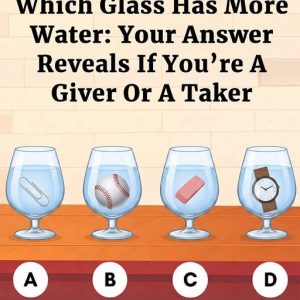
In the version of this puzzle described here, Glass A contains a small paperclip, Glass B holds a baseball, Glass C contains an eraser, and Glass D holds a wristwatch. Assuming all the objects are submerged and the water levels are the same, the paperclip displaces the least water. That makes Glass A the correct answer. The baseball takes up considerably more space, while the eraser and wristwatch occupy more room than the paperclip. Of course, real-world details such as floating objects, different water levels, or unusual object sizes could change the calculation. But under the puzzle’s intended conditions, the smallest submerged object is the key.
Some versions of this challenge go a step further by claiming that your answer reveals whether you’re naturally a giver or a taker. For example, choosing A is sometimes associated with noticing small details and being thoughtful toward others. Choosing B is linked to focusing on what stands out immediately. Selecting C is described as a sign of balance and fairness, while D is associated with careful thinking and considering different possibilities. These interpretations can be entertaining conversation starters, but they aren’t scientifically validated personality assessments. A person’s generosity, kindness, and behavior cannot be reliably determined by choosing a glass in a visual puzzle.
What makes this challenge interesting is how it encourages people to reconsider their assumptions. Some participants answer immediately, while others take their time and work through the problem logically. Neither approach tells us whether someone is a good or bad person. Instead, the puzzle demonstrates how a small detail can completely change our understanding of a situation. Sometimes, the most useful answers come from looking beyond what is immediately visible. And even when a puzzle seems incredibly simple, taking a moment to examine the underlying logic can reveal something unexpected.
💧 Now it’s your turn! Which glass did you choose BEFORE reading the answer?
A — Paperclip
B — Baseball
C — Eraser
D — Wristwatch
👇 Be honest! Did you get it right on your first try, or did the answer surprise you? Tell us in the comments!



This Post Has One Comment